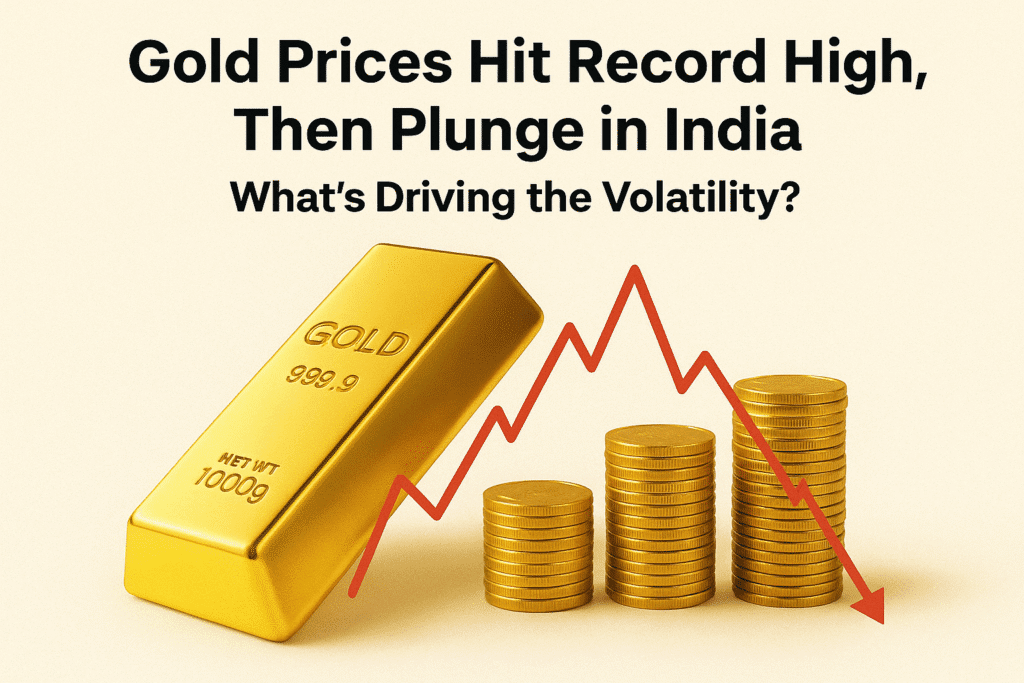
n recent weeks, gold prices in India have captured both attention and caution as the yellow-metal soared to record highs before undergoing a notable drop. The sequence of an all-time high followed by a dramatic fall is prompting investors, families planning jewellery purchases, and market watchers to ask: what happened, why did it happen, and what does it mean going forward?
Thank you for reading this post. Don't forget to subscribe!
Record Highs: What was driving the surge?
At its peak, global spot gold touched roughly US $4,381.21 per ounce, as reported by Reuters, marking an unprecedented rally. In India, this translated into domestic prices climbing steeply — for example, 24-carat gold per 10 grams was quoted at over ₹1.39 lakh, according to live rate aggregators.
Several factors fuelled this surge:
- A weak Indian rupee made imports costlier, pushing domestic gold prices higher.
- Safe-haven demand broadened amid global uncertainty (geopolitical tensions, inflation worries) driving buying interest in gold.
- Expectations of lower U.S. interest-rates and a softer dollar made non-yielding assets like gold more attractive.
- Traditional domestic demand in India (weddings, festivals) amplified the rally as many consumers rushed in to buy before further price jumps.
The Plunge: Why did the price correct so sharply?
Just as suddenly, gold prices began to come off the highs. In one session global spot gold fell more than 5 % — the steepest daily drop in some five years. In India the correction was swift: reports noted a drop of over ₹3,300 per 10 grams for 24-carat, taking the rate back to about ₹1.27 lakh from its peak.
Key reasons behind the fall include:
- Profit-booking by investors who locked in gains after the record highs.
- A stronger U.S. dollar made gold relatively more expensive for rupee-based buyers.
- Some easing in geopolitical tensions and signs that the rush to safe assets may have peaked.
- Domestic shift: with the price at elevated levels, some buyers held back, reducing immediate demand.
What this means for Indian buyers & investors
For households and investors in India, this sequence of surge → peak → drop carries several practical implications:
- For jewellery buyers: If you were waiting for a “dip” to make purchases (for weddings or festivals), the recent drop offers a window. But take note: volatility remains high, so timing is tricky.
- For gold as investment: The recent correction does not necessarily mean the bull run is over — the fundamentals (inflation hedging, currency risk) remain intact — but it does signal that risk-mitigation (e.g., profit-taking, monitoring stop-losses) is now more important.
- Importers & jewellers: They face margin squeezes. Many imported gold when rates were higher; a sharp fall could compress their inventory value and profitability.
- Market watchers: The sharp drop suggests the peak may have been short-lived and that a consolidation or sideways phase might follow.
The path ahead: Will gold rally again or tread cautiously?
Given the global backdrop, several scenarios are possible:
- If inflation remains persistent, central banks delay rate hikes, or new geopolitical shocks arise, gold could once again rally.
- On the other hand, if economic data improves significantly or rate-cuts are postponed, the safe-haven bid could weaken and gold may trade in consolidation.
- Domestic factors — such as changes in import duties, jewellery demand patterns (especially in festive seasons), rupee movement — will also influence Indian gold prices. For recent domestic context see the live rates at a data-provider like the World Gold Council which tracks gold in India.
Conclusion
The story of gold in India over recent weeks — record highs followed by a sharp correction — serves as a reminder that even traditional “safe” assets are subject to significant short-term swings. For India’s consumers, jewellers and investors, the key takeaway is that timing and risk-management matter. The gold rush may not be over, but a measured, informed approach will likely serve better than a rush driven by fear of ‘missing out’.
For those tracking live rates and historical charts of gold in India, you can refer to official data aggregators like GoldPrice.org’s India section.
According to the World Gold Council’s official data, India remains one of the largest consumers of gold, and short-term price fluctuations are often influenced by global market trends and domestic demand. (Source: World Gold Council)
Check out our latest blog on Zerodha’s Big Move: Launching a Fund to Track India’s Top 30 Companies
more about Business & Economy
H-1B Visa Anti-India Sentiment: How Trump Blames Foreign Workers for US Job Crisis

About the Author