
Introduction
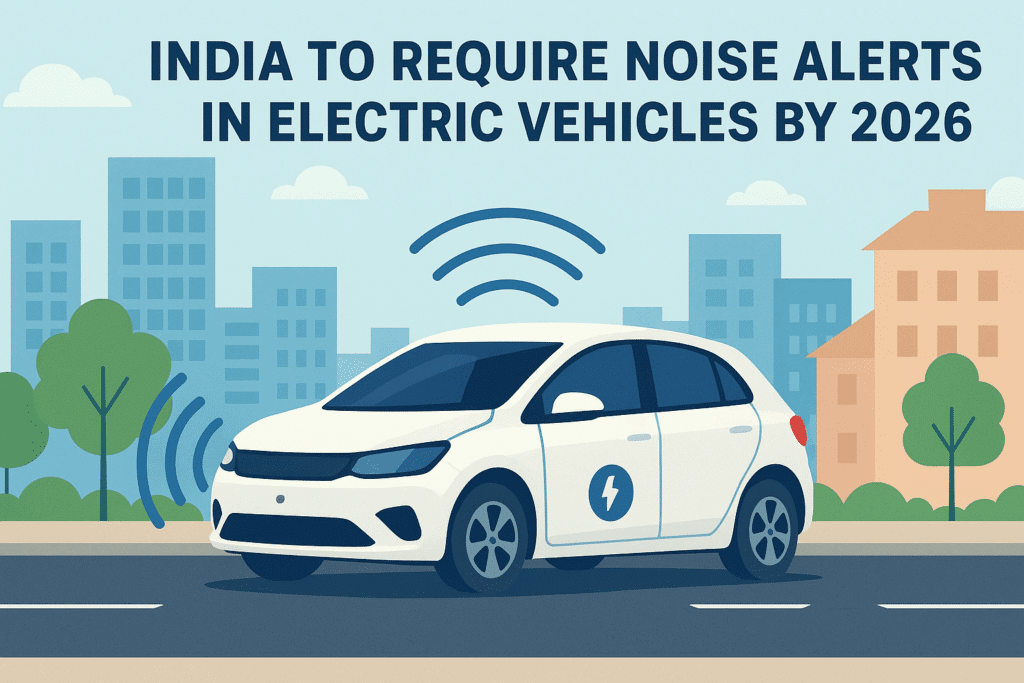
Electric vehicles (EVs) are transforming India’s transport landscape, promising cleaner air and reduced carbon emissions. 🚗⚡ However, their quiet operation poses a safety challenge for pedestrians, especially visually impaired individuals. To address this, the Indian government plans to mandate noise alerts in electric vehicles by 2026, ensuring safer streets while accelerating EV adoption.
Thank you for reading this post. Don't forget to subscribe!
Why Noise Alerts Are Important in EVs
Unlike traditional vehicles, EVs are nearly silent at low speeds. While this reduces noise pollution, it also increases the risk of accidents, particularly in crowded urban areas. Pedestrians often rely on auditory cues to detect approaching vehicles. Introducing mandatory acoustic vehicle alert systems (AVAS) will bridge this safety gap.
According to the Automotive Research Association of India (ARAI), integrating noise alerts can significantly reduce pedestrian accidents caused by silent EVs.
How the Regulation Will Work
Types of Noise Alerts
The government is considering different sound patterns for EVs:
- Warning sounds – Audible signals when vehicles move at low speeds (below 20 km/h).
- Directional alerts – Sounds that indicate vehicle movement direction.
- Speed-based modulation – Volume and pitch change according to vehicle speed.
These alerts must comply with safety and environmental standards while avoiding unnecessary noise pollution.
Implementation Timeline
- 2025: Draft guidelines released for public feedback.
- 2026: Mandatory installation in all new electric vehicles sold in India.
- Post-2026: Retrofitting older EVs may be required depending on state regulations.
Benefits of Noise Alerts in EVs
- Pedestrian Safety – Reduces accidents, especially involving children and visually impaired individuals. 👶🧑🦯
- Enhanced Public Awareness – Drivers and pedestrians can better detect vehicle movements.
- International Compliance – India aligns with global standards, as countries like the US and EU already require EV noise alerts.
- Encourages EV Adoption – Safer vehicles inspire more public confidence in electric mobility.
- Controlled Noise Pollution – Alert sounds are regulated to avoid unnecessary disturbance.
Challenges and Considerations
- Cost to Manufacturers: Integrating AVAS could slightly increase EV prices.
- Standardization: Uniform sound guidelines need to be established to avoid confusion.
- Maintenance: Noise systems require regular checks to ensure functionality.
Despite these challenges, the long-term safety and environmental benefits outweigh the costs.
Example / Case Study
Globally, countries like Japan, the UK, and the US already mandate EV noise alerts. Studies show that pedestrian accidents involving EVs decreased by over 15% after introducing AVAS. India’s adoption of similar regulations could replicate these positive outcomes.
Conclusion
The introduction of mandatory noise alerts in electric vehicles by 2026 is a crucial step for road safety and sustainable mobility in India. While EVs promise a cleaner future, pedestrian safety cannot be overlooked. 🚦 By integrating AVAS, India ensures a balance between innovation, environmental responsibility, and public safety.
Check out our latest blog on Airtel Launches India’s First AI-Powered Location Service
more about Business & Economy
About the Author