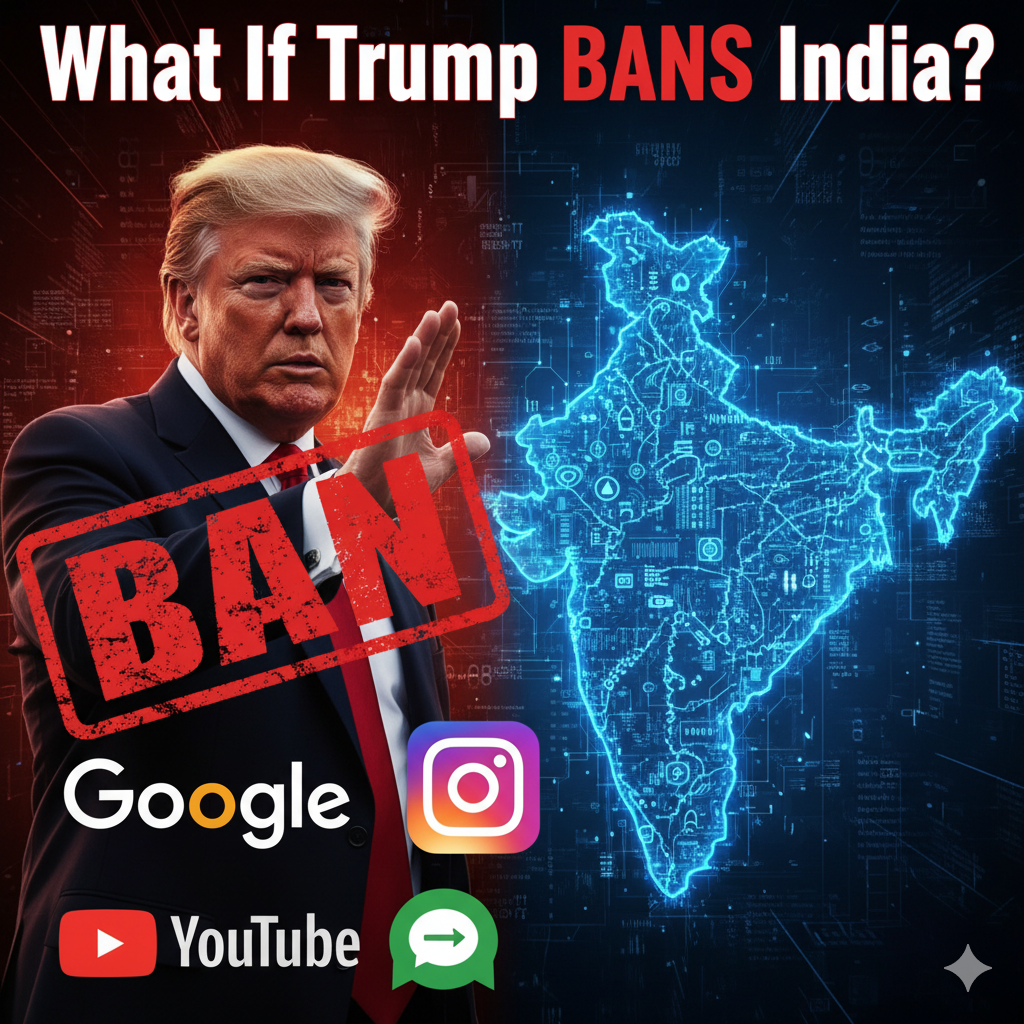
If Trump bans Google and Instagram in India, the digital economy would be shaken.
If Trump bans Google and Instagram in India, our digital lives would change overnight. This question, raised by Indian billionaire Harsh Goenka in a viral post, has sparked nationwide debate. Even Zoho’s founder Sridhar Vembu joined the conversation, emphasizing that India must build its own digital independence to avoid such risks in the future.
Thank you for reading this post. Don't forget to subscribe!
In recent weeks, a major debate has gone viral on social media in India — what if Donald Trump bans India from using American tech platforms like Google, Instagram, ChatGPT, Facebook, or YouTube?
After Harsh Goenka’s tweet went viral, thousands of Indians began discussing what would happen if Trump bans Google and Instagram in India. Social media was flooded with opinions, memes, and serious concerns about how dependent Indian businesses and creators have become on American digital platforms.
Could Trump Really Ban Google and Instagram in India
The discussion began after Indian billionaire Harsh Goenka shared a post that quickly went viral, receiving nearly 1 million impressions. The topic gained even more attention when Zoho’s founder, Sridhar Vembu, responded, emphasizing India’s deep reliance on U.S. technology.
If Trump bans Google and Instagram in India, our digital world could change overnight
This scenario may sound extreme, but it raises a serious question:
👉 What would India do if access to these U.S. platforms were suddenly blocked?
Should India prepare a Plan B for tech independence?
| The idea that Trump could ban Google and Instagram in India is not completely impossible. |
Harsh Goenka — one of India’s top industrialists, often listed in Forbes India’s Top 50 Richest — posted an intriguing hypothetical:
Imagine if Donald Trump passed a new law saying there are too many foreigners using American social media platforms.
Given Trump’s unpredictable decision-making style, this idea, while unlikely, isn’t impossible.
In recent years, there’s been a noticeable rise in anti-India sentiment on platforms like X (formerly Twitter) and Instagram — particularly among some Trump supporters. Many of them argue that “American platforms are for Americans,” especially when discussions involve U.S. issues like H-1B visas.
This growing bias has led many Indians to ask whether the U.S. could one day restrict access to American tech platforms for Indian users.
Zoho’s Sridhar Vembu warned that if Trump bans Google and Instagram in India, it would expose our overreliance on U.S. tech.
Zoho’s founder, Sridhar Vembu, responded insightfully to Goenka’s post. He agreed that India’s dependency on American technology goes far beyond apps like Instagram or YouTube.
He explained that:
- Operating systems like Microsoft Windows and Apple macOS dominate the market.
- Hardware components and chips are mostly designed or manufactured under U.S. influence.
So even if India creates local alternatives to social media apps, true independence would require building our own software ecosystems, chip design capabilities, and digital infrastructure.
Could Trump Really Ban Google and Instagram in India?
Many believe that a scenario where Trump bans Google and Instagram in India is unrealistic — but it’s not impossible. Political pressure and unpredictable policymaking could lead to temporary restrictions or leverage tactics that directly impact millions of Indian users.
Let’s look at the numbers.
U.S. tech giants such as Google, Microsoft, and Meta earn nearly $40 billion annually from India. Interestingly, this revenue isn’t even included in official trade statistics between the two countries.
The idea that Trump could ban Google and Instagram in India is gaining traction
Even if Trump bans Google and Instagram in India, India must be ready with its tech independence plan
So economically, it makes no sense for the U.S. to ban India from using its platforms — it would be a huge financial loss for these companies.
However, politics often overrides logic. If Trump were to face political pressure from his base, or if he saw strategic advantage in using India’s dependency as leverage for trade negotiations, he might take such a drastic step — even temporarily.
After all, we saw something similar when H-1B visas were restricted, even though it didn’t benefit American workers.
Global Lessons: Social Media Bans Lead to Unrest
We can also look abroad for examples. In Nepal, when the government tried blocking Facebook, YouTube, and X, it triggered massive public protests in Kathmandu.
These platforms aren’t just entertainment tools — they’re crucial for communication, business, and freedom of expression.
If the U.S. were to pull these platforms from India, it wouldn’t only hurt India — it would significantly reduce American soft power and influence across one of the world’s largest digital markets.
A Trump ban on Google and Instagram in India would have huge economic consequences.
Zoho’s Sridhar Vembu warned that if Trump bans Google and Instagram in India, it would expose our overreliance on U.S. tech.
Both Harsh Goenka and Sridhar Vembu make an important point — India must invest now in tech independence.
Here’s what India can do:
- Launch a 10-Year National Tech Mission to develop alternatives to U.S. apps and systems.
- Create a $40–50 billion “Tech Independence Fund” to finance Indian startups in AI, cloud computing, operating systems, and semiconductors.
- Promote Indian apps like Zoho’s Arattai, which can grow into strong competitors with the right marketing and user support.
- Collaborate with friendly nations to co-develop open-source technologies and manufacturing ecosystems.
This isn’t about boycotting U.S. products — it’s about building resilience and ensuring that India can thrive, even in uncertain geopolitical scenarios.
Potential Consequences of Trump Bans Google India
A sudden U.S. tech ban would have multiple effects:
- Economic: Loss of billions in revenue for U.S. tech companies and disruptions in India’s digital services.
- Social: Millions of users would need alternatives for communication, content, and AI tools.
- Political: Could increase tensions between India and the U.S.
- Technological: Accelerates India’s need for self-reliance in software and hardware technologies.
Past examples like Nepal’s social media ban show that blocking platforms can trigger public protests. India would need well-planned alternatives to prevent disruption and unrest.
Even if Trump bans Google and Instagram in India, India must be ready with strong local alternatives
As one Indian general once said about Trump — “He himself doesn’t know what he’ll do tomorrow.”
That’s precisely why India must prepare. Whether or not such a ban ever happens, tech independence is no longer optional — it’s a national security and economic priority.
While the likelihood of Trump bans Google India happening may seem low, experts agree that India must act now. Building Indian digital alternatives, reducing dependency on U.S. apps, and launching a long-term tech independence plan are crucial steps. Leaders like Harsh Goenka and Sridhar Vembu emphasize that preparedness is essential.
By investing in local solutions and fostering innovation, India can ensure that even if U.S. tech platforms are restricted, the country’s digital economy will remain resilient. Whatever happens, India should be ready for the day Trump bans Google India.
💬 What do you think India should do to reduce its dependency on U.S. tech platforms?
Share your views in the comment section below! Let’s discuss how India can build a stronger, self-reliant digital future.
About the Author